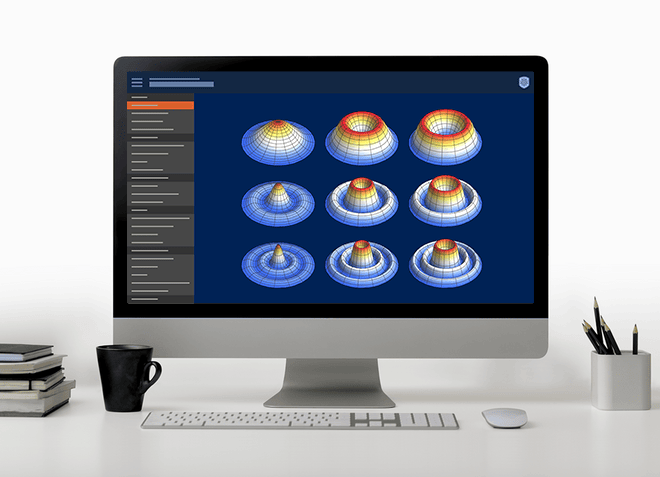
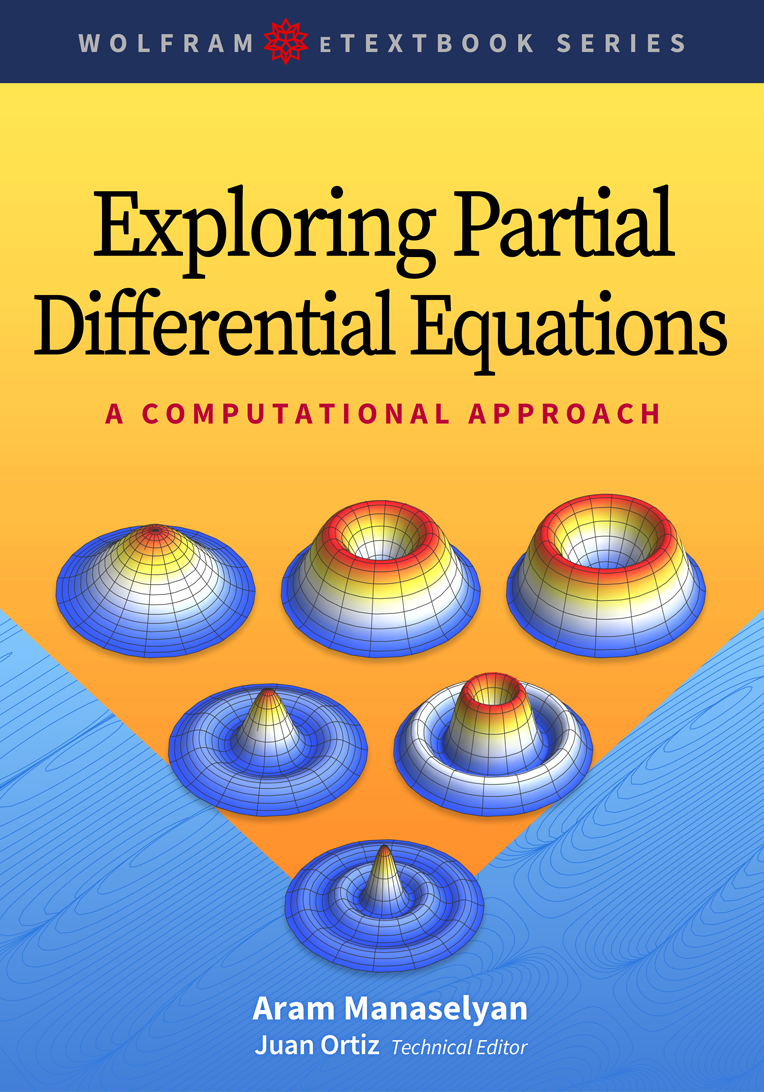
Exploring Partial Differential Equations: A Computational Approach
Aram Manaselyan
Partial differential equations (PDEs) are among the most powerful tools in mathematics, providing the essential framework for describing change, motion and field dynamics. From the flow of heat and the propagation of electromagnetic waves to the complexities of quantum mechanics and modern financial markets, PDEs form the foundation of the technologies and theories shaping our world.
This book provides a practical, accessible introduction to PDEs, uniquely leveraging the computational power of Wolfram Language. By seamlessly integrating symbolic derivation, efficient numerical methods and high-quality visualization, this text allows readers to bridge the gap between abstract theory and real-world application.
The curriculum is designed to build intuition progressively. Students begin with fundamental concepts—such as classification and boundary conditions—before mastering the three classical equations of mathematical physics: the heat, wave and Laplace equations. The journey culminates in an exploration of the most influential equations in modern science, including the Black–Scholes, Schrödinger, Maxwell and Navier–Stokes equations.
To ensure mastery, the text includes a "nutshell" summary study guide and sample exam. Readers can also download the free, interactive ebook edition to engage with live Wolfram Language code. Additional materials, including videos and quizzes, can be found online in the companion Wolfram U course.
Information & Media Inquiries
- Title: Exploring Partial Differential Equations: A Computational Approach
- Author: Aram Manaselyan
- Technical Editor: Juan Ortiz
- Paperback: forthcoming
- Kindle: forthcoming
- Wolfram Notebooks: forthcoming
- Publisher: Wolfram Media, Inc.
- Publication Date: Fall 2026
- ISBN-13: 978-1-57955-138-4 (paperback)
- ISBN-13: 978-1-57955-139-1 (Kindle)
- ISBN-13: 978-1-57955-140-7 (Wolfram Notebooks)
Publicity and Interviews: publishing@wolfram.com
Translation Rights Requests: info@dropcap.com
Non-fiction
Contents
- Acknowledgements
- Foreword
- What Is a Partial Differential Equation?
- Basic Terminology for PDEs
- Initial and Boundary Conditions
- Classification of Linear Second-Order PDEs
- Linear First-Order PDEs
- Nonlinear First-Order PDEs
- Applications of First-Order PDEs
- Introduction to the Heat Equation
- Solving the Heat Equation
- Applications of the Heat Equation
- Introduction to the Wave Equation
- Solving the Wave Equation
- Applications of the Wave Equation
- Introduction to the Laplace Equation
- Solving the Laplace Equation
- Applications of the Laplace Equation
- The Beam Equation
- PDEs in Two Spatial Dimensions
- PDEs in Three Spatial Dimensions: Cartesian Coordinates
- PDEs in Three Spatial Dimensions: Spherical Coordinates
- The Black—Scholes Equation
- The Schrödinger Equation
- Maxwell's Equations
- The Navier—Stokes Equations
- Partial Differential Equations in a Nutshell
- Sample Exam
- References
Companion Online Course Introduction to Partial Differential Equations
Wolfram U interactive courses are hosted on the Wolfram Cloud and allow you to interactively explore concepts using Wolfram Language functionality. This interactive course includes video lessons, practice problems, quizzes, a final exam and a chat-based Course Assistant (requires AI Access). Two shareable certificates are available: course completion and Wolfram Level 1 certification for proficiency in partial differential equations. Work through the course content at your own pace and use the built-in progress tracker as you advance. Get started with our free courses by signing in to the Wolfram Cloud with your Wolfram ID—or create one; it's free!
See Course Details