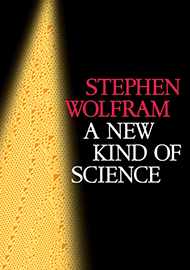
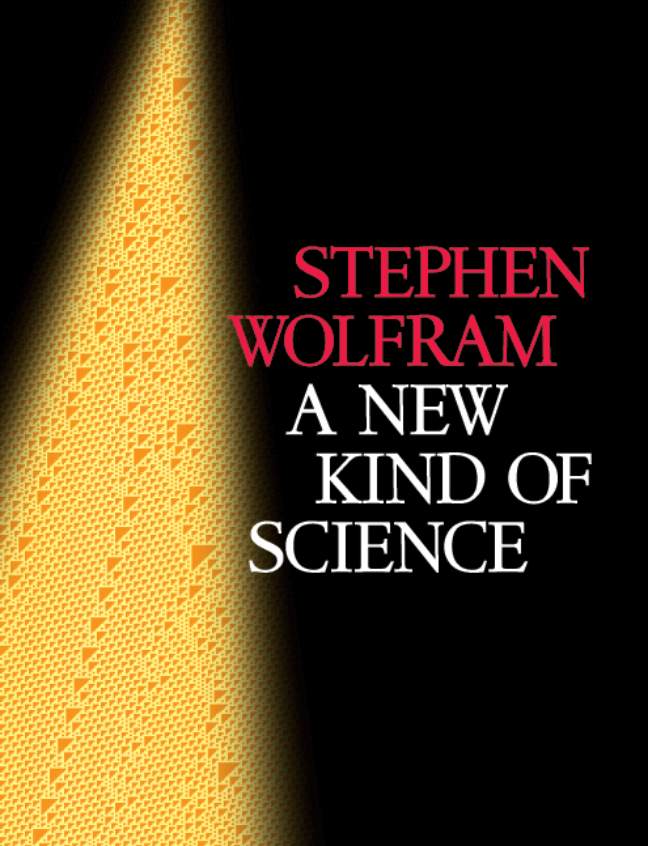
A New Kind of Science
Stephen Wolfram
Starting from a collection of simple computer experiments—illustrated in the book by striking computer graphics—Stephen Wolfram shows how their unexpected results force a whole new way of looking at the operation of our universe.
Wolfram uses his approach to tackle a remarkable array of fundamental problems in science, from the origins of apparent randomness in physical systems, to the development of complexity in biology, the ultimate scope and limitations of mathematics, the possibility of a truly fundamental theory of physics, the interplay between free will and determinism, and the character of intelligence in the universe.
Information & Media Inquiries
- Title: A New Kind of Science
- Author: Stephen Wolfram
- Hardcover: $44.95 1280 pages
- Paperback: $14.95 1280 pages
- Kindle: $9.99 1280 pages
- Publisher: Wolfram Media, Inc.
- Publication Date: May 14, 2002
- ISBN-13: 978-1-57955-008-0 (hardcover)
- ISBN-13: 978-1-57955-025-7 (paperback)
Publicity and Interviews: sw-media@wolfram.com
Translation Rights Requests: info@dropcap.com
Trim Size: 8.14" x 9.7"
Non-fiction
Distribution by Ingram and Amazon
UK Distribution: Turnaround Publisher Services
Contents
- Preface
- The Foundations for a New Kind of Science
- The Crucial Experiment
- The World of Simple Programs
- Systems Based on Numbers
- Two Dimensions and Beyond
- Starting from Randomness
- Mechanisms in Programs and Nature
- Implications for Everyday Systems
- Fundamental Physics
- Processes of Perception and Analysis
- The Notion of Computation
- The Principle of Computational Equivalence
- Notes
- Index